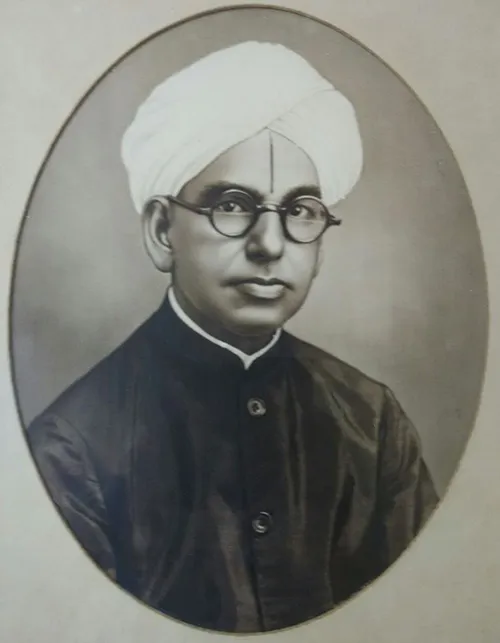
Early life
Sixty eight years may not be a very long life, at least by modern standards, but how much one can pack into it, can be best seen in the life of Pandit Duraiswami Aiyangar. It wasn’t as if fortune smiled on him, at birth. Quite the opposite. Born to a Sanskrit scholar, Vijayaraghavachar and his wife, Ranganayaki, in Melpakkam, Tamil Nadu, Pandit Duraiswami, then called Srinivasavaradhan lost his mother when he was barely five. A few years later, his father too expired during an epidemic of cholera. What the little lad was left with was a small sum of money and an even smaller sister to take care of. Unfazed, he set out to Madras (as Chennai was called then) to earn a livelihood. But destiny had other plans. His bundle of money was stolen as he stopped at a wayside temple pool to have a bath. He and his little sister spent the night outside the ancient Utharamerur temple – a beautiful temple built during the Pallava reign. Penniless, homeless, he was utterly without recourse when, once more, the wheels of fate turned. A childless couple, an Ayurveda doctor, Gopalacharulu and his wife visited the temple and happened to speak to the priest about the two little children and took the two children under their wing.
One does not quite know who was luckier – the little boy who received an unexpected guardian or the doctor who acquired an able assistant. For the lad’s curious mind and meticulous approach were just the right ingredients necessary to fashion a wonderful protégé. More than anything, Srinivasavaradhan was a sponge, absorbing everything that came his way. It was as if his soul yearned for knowledge and the more he studied, the greater grew his thirst. Tamil, English, Malayalam, Telugu and even a little known language, Manipravalan – an ancient script version of Tamil was what he translated the Sanskrit works to. In those days that was the more common language of his people. He grew to be a handsome boy with a commanding personality and hence came to be called Duraiswami – the master, the chief, the leader.
As an apprentice under Pandit Dr Gopalacharulu, Duraiswami not only observed and learned how to heal but also studied how to create medications. In 1908, when he was barely twenty years of age, he took his medical diploma from S.K.P.D. Ayurveda College (now the Madras Ayurveda College), as an external student and needless to say, passed it with flying colours.
Duraiswami got married soon after he graduated as a doctor and had no children by his first marriage. Almost 10 years later, he married again, as was the custom in those days. Kanakavalli was a young 13 year old girl from Tiruvallur, Echambadi family. His first child, a son, Vijayaraghavan was born in 1922, followed by 5 more children in quick succession. Now he had a growing family and a huge responsibility of bringing up his growing family.
Much later, his daughter, Vaijayanti would recount how he would learn languages by trying to decipher posters on walls, putting known letters together to comprehend meanings of words, thus also pinning down unknown letters. It must have been a mammoth effort, but the lad was more than ready for it. And yet, this was not all. Since the study of Ayurveda necessitated a knowledge of Sanskrit, he took to it, literally like fish to water, excelling in what was often referred to as the scholar’s language. All this without once entering the premises of a school! Self-motivated, pushing boundaries, discovering books, exploring concepts, coming to grips with ideas, this was an extraordinary intellect exploding with energy.
Physician and reformer
His enquiries into the field of Ayurveda resulted in the creation of several medications, Kashayams, Bhasmams, Chyvanaprashams, tooth powders, hair oils, and all kinds of natural remedies for good health. The world slowly started to get to know him and steadily accolades started coming his way. He was to teach at the Madras Ayurveda College, become an examiner for the Medical College Board Examinations at Ceylon (present day Sri Lanka) and Burma (present day Myanmar) and was an activist in revitalizing indigenous medicine in colonial India. Pandit Duraiswami Aiyangar joined as a chief physician of SKPD Trust’s free Ayurvedic hospital at George Town in Madras after the resignation of Pandit D. Gopalacharlu.
Pandit Duraiswami Aiyangar’s research also led him to publish articles in papers disseminating information to the layman on general well-being and then far more scientific and technical papers in ayurvedic periodicals. He established Vaidya Kalanidhi Kāriyālayam through which he started to publish translations of medical texts such as Sāraṅgadhara Saṃhitā, Aṣṭāṅga Hṛdayam, Mādhava Nidānam and Rasaratna Samuccayam and also started the Tamil medical journal Vaidya Kalanidhi. He continuously wrote and illustrated the modern anatomy with Sanskrit terminology in Vaidya Kalanidhi. Soon he was translating ancient palm-leaf manuscripts into Tamil, providing commentaries for published material. His extensive commentary titled “Nandini” on Anandaraya Makhin’s allegorical play Jivanandanam, is voluminous, well researched and the only way the multi-layered meaning of the original text can be understood.
His translation and commentaries, Ashtanga Hrudayam and Rasaratna Sammucchayam are used even today as respected Ayurvedic texts in colleges of education, some of these being translated into Tamil.
This amazing output, varied and comprehensive, could obviously not go unnoticed. He was honoured with titles like Vaidyaratna (Gem amongst doctors); Pandit (Scholar); Ayurveda Bhusana (Doyen amongst doctors), Ayurvedacarya (Teacher of Ayurveda) and Sri Desika Darsana Dhurandhara (a scholar of Swami Desika’s works). He was elected President of the All India Medical Association and was selected to deliver the Keynote or Presidential Address at the All India Medical Conference held in Trivandrum, in the state of Kerala.
During the Colonial period Ayurvedic physicians felt a sense of insecurity, while the colonial state used Western medicine as a cultural force to establish superiority over Ayurvedic medicine. Pandit Duraiswami Aiyangar and his mentor Pandit D. Gopalacharlu, were involved deeply in the revitalisation movement. He indicated the cause for the fall of Ayurveda as:
Presently, some are calling themselves as ayurvedic physicians after reading one, or two medical texts or after knowing to prepare one or two medicines. Most of, them have not studied courses such as anatomy, diagnostic techniques, Materia, Medica, symptoms of diseases etc., through the institutions which teach Ayurveda, with the help of authentic Sanskrit Texts. This is the main reason for the fall of Ayurveda.
Vaidya Kalanidhi, 5(10), 1918, p. 149
In order to improve the qualification of the students and practice of Ayurveda, as the President of the Ayurveda Mahamandal, Pandit Duraiswami, put together a legitimate corpus of core of Ayurveda texts such as Caraka, Sushruta, Mādhava Nidana, Aṣṭāṅga Hrdayam, Bhavaprakāsha, Sāraṅgadāra Samhita, Rasaratṉa Samuchchaya, many of which he himself translated into Tamil. He also made it a requirement to pass Sanskrit examinations at Vishārath or Āchārya levels to qualify and practice Ayurveda.
Duraiswami Aiyangar published modern anatomical illustrations in his journal and at the same time, tried to equate ayurvedic Sanskrit terms with modern anatomical terms. Ayurvedic physicians in the twentieth century reconstituted these terms to match modern anatomy.
After India came under the British rule, English system of medicine has come into vogue. The Legislative council during Lord Willingdon’s days devoted some attention to the indigenous system and Doctor Koman’s report was the outcome of it. Pandit Duraiswami, did not hesitate in critiquing the attitude of the Colonial Government, proving that indigenous medicine is not unscientific or irrational (Vaidya Kalanidhi 6(6), 1918 p95). Pandit Duraiswami Aiyangar observed the activity of the government and pointed out that the Government was adopting various tactics with the object of uprooting the Ayurvedic and Unani systems and firmly establishing the western system in their place, and furthering the trade in western medicines. The appointment of Doctor Koman to make an investigation into the indigenous systems of medicine is the principle one among such tactics. While Doctor Koman’s report has, with the object of ruining the Ayurvedic system, been framed in such a manner that the trade in English medicines in this country may be advanced and that the western system of medicine may be deemed by our countrymen to be superior (NNPR, 1921).
Pandit Duraiswami Aiyangar criticised Koman in his article, entitled, “The Report of Dr. Koman on Indigenous Systems of Medicine,” published in the journals Vaidya Kalanidhi and Swadesamitran. He questioned the competency of Dr. Koman either to grant a certificate of merit to Ayurveda or to decry it (NNPR 1921). Duraiswami Aiyangar asserted that it would not have been possible for him to study the principles of Ayurveda and had no authority to assess the efficacy of Ayurvedic medicine. He was neither consulting with eminent experts and heads of Ayurvedic associations like All India Ayurveda Mahamandal, All India Ayurveda Vidyapeeth, nor seeking assistance from learned Ayurvedic physicians for his report. Being a servant of the government, there was no surprise that his report was biased (NNPR 1921).
Poet, philosopher and scholar
All these, by themselves would have been impressive achievements, one that could have earned Pandit Duraiswami Aiyangar a place in history. Yet, such was his genius that it could not be contained within narrow definitions or fitted into fixed categories. Science and languages were not his only obsession. He found within himself a passion for literature, a love for poetry. And it soon expressed itself in an altogether different form of writing. For him, the Sanskrit poet, Mahakavi Kalidasa was not merely an inspiration to read. Commentaries were written for his work, translations done. At a mere 21 years of age, he had already translated Kalidasa’s Kadambari; at 23, Meghsandesa. Such was his ability that he was a linguist who spoke Sanskrit, Tamil, Malayalam, Telugu, Manipravalan and English fluently and with ease.
And then philosophy beckoned. After all, Duraiswami Aiyangar belonged to a highly respected sect of Brahmins – the Vaishnavas, who held as their guru acharyas like Ramanuja and Vedanta Desikan. Steeped in the traditions of his ancestors, Duraiswami Aiyangar now took up the works of Vedanta Desikan to make them available to a wider audience in Tamil. But, amidst all this fervour and zeal, this remarkable man still found time for other pursuits. He acted in plays and took part in debates at the Sugunavilasa Sabha, a meeting place for the intellectual elite of erstwhile Madras Province.
But amidst the plethora of accomplishments, if there is one thing that Duraiswami Aiyangar will best be known for, it is that he was a scholar’s scholar. Dedicated, scrupulous to the point of being perfect, it is believed that he was the first to create a glossary of words that could be referenced back into the book, an indexing system that must have been Herculean considering that it was done entirely manually.
Final years
However, if there was one impediment on his path, at all times, financial constraint dogged him constantly. His personal life was rife with challenges, where he had the responsibility of taking care of two wives and six children. Probably that is why he was unable to print multiple copies of his books, selling a few when he had the wherewithal to do so. And yet, incredibly his books have found their way across the globe from New York, Chicago, the Library of Congress, Washington to Paris, Cambridge and even Oxford.
It was clear that this candle was burning extremely brightly. How then could it burn long? At a mere sixty eight years of age, on 2nd Dec 1956, this inspiring figure passed away. Such however was his fame, that the then Governor of Madras, Sri Prakasham himself came to pay his respects to him. The question we must ask ourselves is – can we afford to forget him?